Features:
- High exchange capacity
- High mechanical strength
- Uniform particle size with good hydraulic characteristics
- Good selectivity
- Good thermo-tolerant characteristics
- Excellent physical and chemical stability
Specifications:
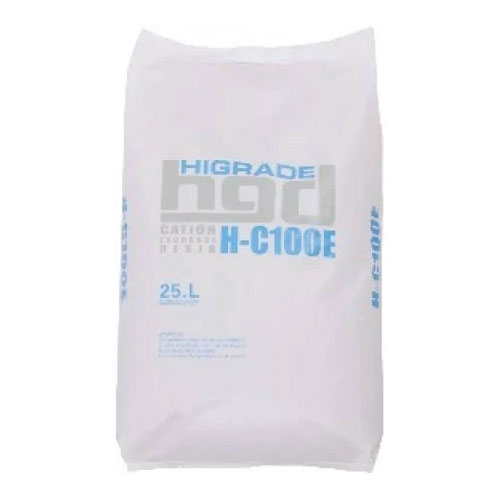
Polymer structure Gel polystyrene crosslinked with divinylbenzene
Functional group HSO3–
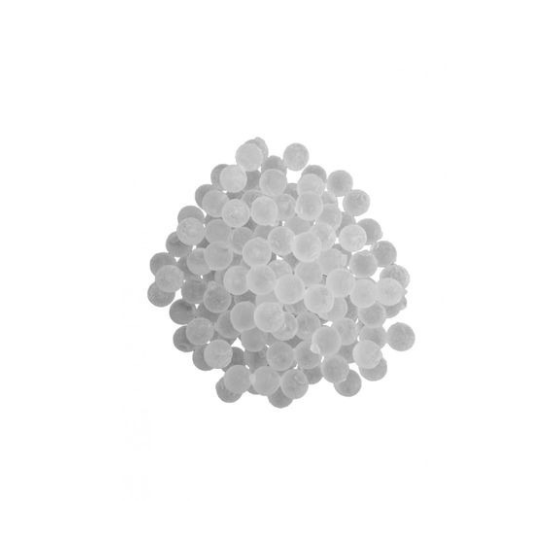
Appearance Spherical light brown bead
Ionic form Na+ type
Total exchange capacity ≥4.5 mmol/g (dry) (Na+ type)
Total exchange capacity ≥1.9 mmol/ml (Na+ type)
Moisture content 46-50% (Na+ type)
Density 1.25 – 1.29 g/ml (Na+ type)
Shipping weight 0.77 – 0.87 g/ml (Na+ type)
Particle size 0.315 – 1.25 mm ≥95%, <0.315mm ≤1%
Effective particle size 0.40 – 0.60 mm
Uniformity coefficient ≤ 1.7
Attrition rate ≥ 90%
Swelling ≤ 10% Na+ – H+
Operating Conditions:
Operating temperature ≤ 120°C
Bed depth ≥ 800 mm
Service flow rate 5 – 25 BV*/h
Service flow rate ≤ 40 m³/h
| Regenerant |
NaCl |
HCl |
H2SO4 |
| Consumption (as 100%) |
80-220 g/L |
50-150 g/L |
80-240 g/L |
| Concentration |
5-10% |
5-8% |
0.7-6% |
| Flow Rate |
2-8 BV*/h |
2-5 BV*/h |
2-20 BV*/h |
Contact Time ≥ 30 min
Slow Rinse 2 BV* (Regeneration flow)
Fast Rinse 4-8 BV* (Service flow)
*Note: 1BV=1m³ water / 1m³ resin
Operating Performance:
The operating performance of HG-C100 in the sodium cycle depends on:
- a) The amount and concentration of regenerant used.
- b) The total hardness of the water to be treated and its sodium content.
- c) The flowrate of the influent water through the bed.
Performance is usually assessed in terms of the residual hardness in the treated water. Under industrial food and beverage manufacturing conditions, treated water with less than 5 mg/L of hardness, can be obtained with a level of 70-80 kg salt per cubic meter of resin. In domestic softening, residual hardness at these comparatively low levels is not usually required, and quite high flowrates are often in use with negligible effect on the operating capacity.
The most efficient use of regenerant can be achieved by using high concentrations of salt, and giving adequate contact time.
Hardness leakage under the standard industrial operating conditions is normally less than 1% of the total hardness of the influent water, and the operating capacities are not significantly affected unless the raw water contains more than about 25% of its exchangable cations as sodium (or other univalent) ions.
Chemical and Thermal Stability:
HG-C100E is insoluble in dilute or moderately concentrated acids, alkalies, and in all common solvents.
However, exposure to significant amounts of free chlorine, “hypochlorite” ions, or other strong oxidizing agents over long periods of time will eventually break down the crosslinking. This will tend to increase the moisture retention of the resin, decreasing its mechanical strength, as well as generating small amounts of extractable breakdown products. Like all conventional polystyrene sulphonated resins, it is thermally stable to higher than 150°C (300°F) in the alkali (for instance, sodium) or alkaline earth (calcium and magnesium) salt forms. The free acid form tends to hydrolyse in water at temperatures appreciably higher than 120°C (250°F) thereby losing capacity, as the functional groups are gradually replaced by hydroxyl groups.